
That Dance Degree Everyone Questioned? It Just Unlocked a Career Path You Never Knew Existed
How many times have you heard “What are you going to do with a dance degree?” How often have you defended your choice while secretly wondering if they were right? How many relatives suggested you get a “real” degree as backup?
They were wrong. Your dance training is extraordinarily valuable—just not in the conventional performance-or-teaching dichotomy dance programs present as your only options.
The Career Path Dance Programs Never Mention
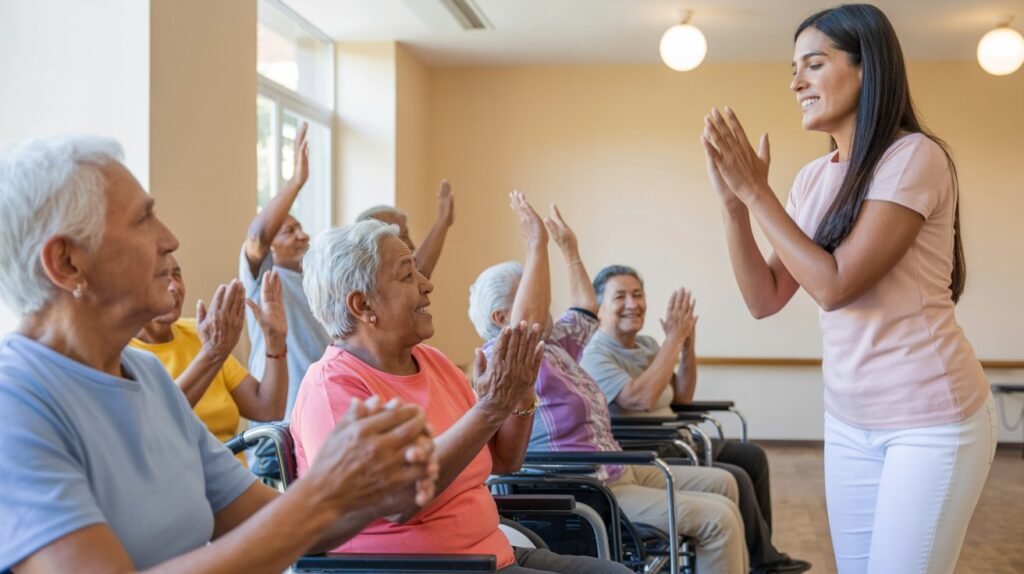
Dance education prepares you for performance companies or studio teaching. Those are framed as the viable paths. But there’s a third option gaining momentum: senior wellness instruction using rhythm-based movement programming.
This isn’t what you do when you “give up” on dance. It’s a sophisticated application of movement expertise to a rapidly growing population with critical needs that dancers are uniquely qualified to address.
Your Movement Analysis Skills Are Irreplaceable
All those hours studying Laban, Bartenieff fundamentals, and kinesthetic awareness? They translate directly to working with aging bodies experiencing mobility limitations.
You can observe movement patterns, identify compensations indicating pain or instability, recognize when someone’s balance is compromised, and adapt choreography instantly for physical constraints. Fitness instructors without dance backgrounds simply cannot read bodies with this level of nuance.
This analytical ability enables you to keep seniors safe while maximizing their movement potential—an essential combination in senior wellness.
Your Choreographic Mind Solves Problems
Creating choreography taught you to solve movement puzzles: how to make this transition work, how to create interest within limitations, how to build sequences that progress logically while remaining accessible.
These exact skills apply when designing rhythm-based movement for mixed-ability senior groups. You’re choreographing for wheelchairs and walkers, cognitive impairment and full cognition, severe arthritis and relative mobility—all within the same class.
Your ability to see movement possibilities where others see only limitations makes you exceptional at inclusive programming.
Your Kinesthetic Intelligence Is Your Superpower
Dancers possess embodied knowledge that can’t be taught from textbooks. You understand how weight shifts affect balance, how momentum carries movement, how spatial awareness prevents collisions, and how breath supports motion.
This kinesthetic intelligence allows you to cue movement in ways that make sense to bodies, not just minds—crucial when working with dementia patients who can’t process verbal instructions but can follow physical demonstration and rhythmic patterns.
Your Performance Training Prepared You Unexpectedly
Years of performing taught you to command attention, read audiences, project energy, recover gracefully from mistakes, and create experiences rather than just execute technique.
Leading senior wellness classes requires identical skills. You’re creating experiences, not just teaching movements. You need stage presence to engage reluctant participants. You must read subtle audience cues to gauge energy and adjust pacing. You’ll need grace when unpredictable moments arise (and with dementia populations, they always do).
Your performance background already developed these essential facilitation skills.
Your Understanding of Music and Rhythm
Dance training gave you sophisticated musicality. You don’t just hear rhythm—you embody it. You understand phrasing, syncopation, tempo, and how musical structure supports movement.
This musicality proves invaluable in rhythm-based senior wellness. You can use rhythm therapeutically, design movement that flows naturally with music, and help non-dancers find rhythm in their bodies. Your ability to make rhythm visible through movement bridges music and motion in ways that engage seniors across cognitive levels.
The Body Awareness You Can’t Unlearn
Your proprioceptive awareness—knowing where your body is in space, how it’s moving, what muscles are engaging—allows you to teach body awareness to others.
For seniors experiencing age-related proprioceptive decline (a major fall risk factor), your ability to guide internal body awareness through movement is genuinely therapeutic. You’re not just leading exercise—you’re teaching embodied mindfulness that improves safety and function.
What Your Dance Degree Didn’t Cover
Your training gave you deep movement knowledge. What it didn’t provide: understanding how aging affects movement capacity, techniques for working with dementia and cognitive decline, methods for adapting choreography for severe physical limitations, business skills for independent contractor work, and knowledge of senior care environments.
InstruMix certification addresses these specific gaps, showing you how to apply your dance expertise to senior wellness contexts while building a sustainable practice.
The Sustainable Career Your Body Can Actually Handle
Here’s what dance programs don’t tell you: high-impact performance and teaching have expiration dates. Your body won’t sustain floor work, high jumps, and repeated demonstrations indefinitely.
Senior wellness instruction is low-impact. You’re modeling gentle movement, using percussion instruments, leading rhythm-based activities your body can demonstrate comfortably for decades. This work doesn’t destroy your joints—it preserves them while keeping you connected to movement.
Why This Matters Beyond Just You
Seniors desperately need movement instruction from people who actually understand bodies. Most senior “exercise classes” are led by well-meaning staff with minimal movement training. The programming is generic, uninspired, and often biomechanically questionable.
You bring sophistication, safety, and artistry to senior movement. Your dance degree prepared you to see movement possibilities, create accessible beauty, and honor bodies at every ability level.
The Validation You’ve Been Seeking
For years you’ve justified your degree. You’ve worked multiple jobs to support your dance practice. You’ve defended your choice to family members who questioned its practicality.
InstruMix offers validation: your dance training has immense practical value. Senior communities need your expertise. Your degree prepared you for meaningful work that provides financial stability while honoring your movement knowledge.
The dance degree everyone questioned just became your pathway to sustainable career and purpose.