
Your Dance Training Solved a Problem You Didn’t Know Existed (And Created Your Next Career)
When you chose dance, people asked if you had a backup plan. When you explained your major, relatives exchanged concerned glances. When you graduated, the questions shifted to “So what’s next?”—implying your degree led nowhere practical.
Here’s what nobody told you: while you were learning movement, an entire population was developing a crisis that only people with your training can solve.
The Senior Movement Crisis No One’s Addressing
America’s aging population faces a critical problem: they’re losing mobility, balance, and physical confidence at alarming rates. Falls are the leading cause of injury-related death among older adults. Physical inactivity accelerates cognitive and physical decline.
Yet most senior facilities offer movement programming led by staff with minimal training. Generic chair exercises. Uninspired stretching. Activities designed by people who don’t actually understand how bodies move.
The result? Seniors decline faster than their diagnoses predict. They lose independence unnecessarily. They stop moving because nothing engages them.
Your dance degree prepared you to solve exactly this problem.
What Dance Training Actually Prepared You For
Spatial reasoning under pressure. You learned to navigate complex spatial patterns while remembering choreography, monitoring other dancers, and maintaining artistic quality. This translates directly to managing senior group classes where some use walkers, some sit, some stand, and everyone needs different spatial accommodations simultaneously.
Movement quality over quantity. Dance taught you that how you move matters more than how much. This philosophy is essential for senior wellness, where quality movement prevents injury and builds confidence, while quantity-focused exercise creates frustration and risk.
The relationship between breath and movement. You understand instinctively how breath supports motion, releases tension, and creates flow. For anxious seniors or those with Parkinson’s, this breath-movement connection you embody becomes a teaching tool that reduces symptoms and improves function.
Improvisation within structure. Your training in improvisation taught you to stay present, respond to what’s happening, and create meaningful movement spontaneously. Leading senior classes with dementia patients requires identical skills—you’re constantly improvising within rhythmic structure as you respond to unpredictable moments.
Creating emotional resonance through movement. Dance taught you that movement communicates beyond words. For seniors with aphasia, advanced dementia, or language barriers, your ability to create connection through movement becomes their primary access point to engagement and community.
The Physical Vocabulary Others Don’t Have
You possess movement language that non-dancers lack. You can describe sensation, quality, and effort in ways that help people find movement in their bodies.
When a senior says “I can’t move like that,” you have fifty ways to modify the movement, ten different verbal cues to try, and embodied understanding of what might be blocking them. You can see what they’re doing versus what they’re attempting and bridge that gap.
Fitness instructors count reps. You create movement experiences. That difference matters profoundly in senior wellness.
Your “Useless” Dance History Knowledge
Remember studying dance history? Martha Graham’s contraction-release, Merce Cunningham’s chance operations, Pina Bausch’s emotional landscapes? That felt theoretical and impractical.
But understanding how different movement vocabularies emerged and what they communicate gives you versatility in senior programming. You can draw from ballet’s structured elegance for residents who value formality, incorporate modern dance’s emotional expression for those needing catharsis, or use postmodern improvisation for dementia patients who can’t follow set choreography.
Your historical knowledge creates cultural and stylistic range that makes programming resonant across diverse senior populations.
The Adaptation Skills You Developed Without Realizing
Every time you learned choreography set on a different body type, you adapted. Every time you worked through injury while still participating in class, you modified. Every time you taught movement to someone with different abilities, you problem-solved.
Senior wellness requires constant adaptation. Every participant has different limitations—arthritis, hip replacements, vision loss, cognitive impairment, wheelchair use. Your entire dance training was essentially preparation in real-time adaptation.
You’ve been developing these skills for years. You just didn’t know they’d become your professional differentiator.
The Community-Building You Already Know
Dance companies and classes create community through shared physical experience. You understand how moving together builds connection beyond words, how ensemble work requires deep listening, and how supporting others’ movement creates trust and belonging.
These concepts apply identically to senior wellness. You’re creating communities through rhythm and movement. Isolated seniors connect through shared rhythm-making. Dementia patients who can’t converse still participate in ensemble movement. Your understanding of physical community-building addresses the loneliness epidemic in senior care.
What InstruMix Adds to Your Existing Knowledge
Your dance training is comprehensive. What it didn’t cover: how aging specifically affects movement systems, cognitive impairment’s impact on motor learning, percussion instruments as movement tools, working within senior care facility structures, and building independent contractor businesses.
InstruMix certification provides these missing pieces, showing you how to apply your dance expertise specifically to senior populations while establishing sustainable income.
The Career Arc That Actually Makes Sense
Dance careers traditionally peak young and decline as bodies age. By your late 30s or 40s, performance opportunities vanish and high-impact teaching becomes unsustainable.
Senior wellness instruction inverts this trajectory. Your value increases as you age—you better understand aging bodies, develop deeper patience, and create more authentic connections with senior participants. You can teach this work into your 60s and 70s because it’s low-impact and valued specifically for mature perspective.
Your dance degree didn’t prepare you for a short career. It prepared you for a long one, if you know where to apply it.
The Impact That Goes Beyond Performance
Performance creates temporary beauty for audiences. Senior wellness instruction creates sustained quality of life for participants.
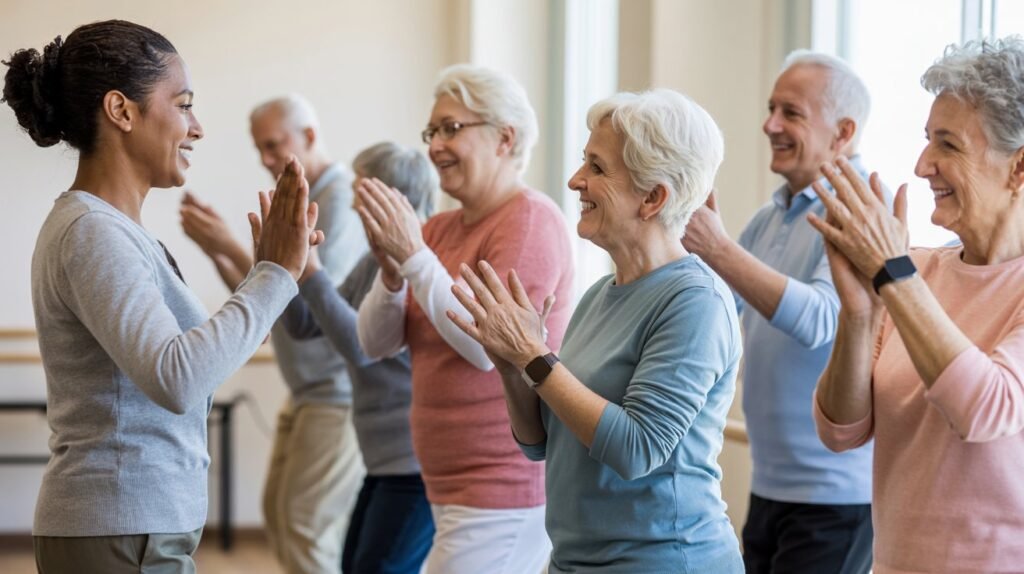
You’ll watch isolated seniors connect through shared rhythm. You’ll see Parkinson’s patients move more fluidly when music guides them. You’ll witness dementia patients light up during movement they can access when everything else is confused.
This isn’t lesser impact than performance. It’s different impact—immediate, tangible, and life-changing for people who desperately need what you offer.
The Truth About That “Impractical” Degree
Your dance degree was never impractical. The problem was limited vision about where dance knowledge applies.
The degree everyone questioned just became your qualification for meaningful work with genuine demand, sustainable income, and lasting impact.